Oct 09, 2026

Sep 22, 2026

Sep 21, 2026

Sep 21, 2026
B4, Qingdao High-Tech Zone, No. 17 Songyuan Road, Qingdao.
+86 13864822549
A car lift is one of the most frequently used machines in an auto repair shop. Whether technicians are doing tire service, chassis inspection, wheel alignment, oil replacement, or general maintenance, the lift directly affects working efficiency and safety.
However, many lift problems and safety risks are caused not by the equipment itself, but by incorrect operation. For example, the vehicle is not positioned in the center, the lifting pads are not aligned with the correct lifting points, the safety lock is not confirmed before work, or the operator lowers the lift without clearing tools and people from the working area.
This guide explains the standard operating procedure for Haosail car lifts, helping auto repair shops use the equipment correctly, reduce downtime, and protect both technicians and vehicles.
Before using the car lift, the operator should complete a basic inspection of the working area, equipment, and personal protection.
First, check the working environment. Remove tools, oil stains, waste, tires, and other obstacles from the lifting area. Make sure no people are standing inside or around the lifting zone.
Second, check the power supply. The voltage should match the equipment requirement, and all wiring should be firm and secure. If the power supply is unstable, the lift may fail to rise smoothly or the motor may be damaged.
Third, inspect the hydraulic system. The hydraulic oil level should be normal, and there should be no leakage from oil pipes, joints, cylinders, or the power unit.
Fourth, check all safety parts. Safety locks, limit switches, steel wire ropes, swing arm positioning devices, and emergency stop buttons must be in good working condition.
Finally, the operator should wear proper work clothes and safety shoes. Long hair should be tied up, and loose clothes should be avoided to prevent contact with moving parts.
Drive the vehicle slowly into the lifting area. The most important rule is to keep the vehicle’s center of gravity close to the center of the lift.
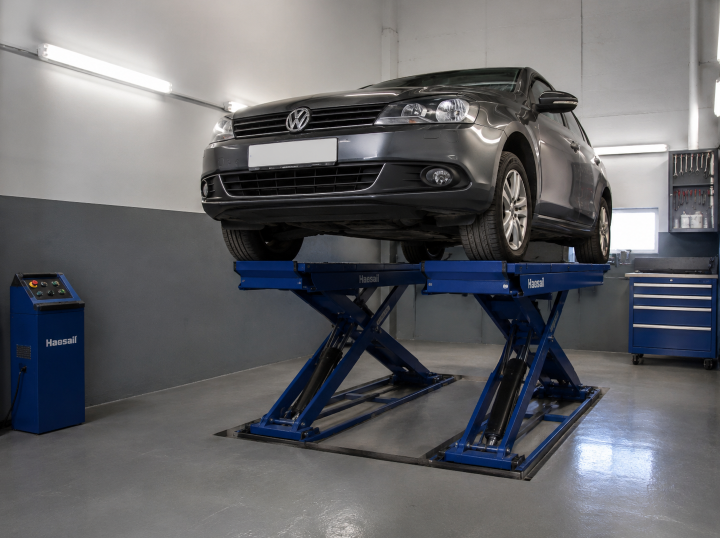
For two-post and gantry lifts, the vehicle should be positioned close to the plane between the two columns. For four-post and scissor lifts, the vehicle should be placed near the center of the platform.
Incorrect vehicle positioning can cause uneven loading, unstable lifting, and unnecessary stress on the lift structure. Before lifting, the operator should check the vehicle position from both sides and make sure the wheels or lifting points are properly aligned.
After the vehicle is in position, adjust the swing arms, support arms, lifting pads, or clamps according to the vehicle type.
The lifting pads must be aligned with the manufacturer-recommended lifting points of the vehicle. The pad height should be adjusted until it fits the chassis firmly. The contact surface should be stable and should not press against weak body panels, plastic parts, pipes, or suspension components.
For motorcycle lifts, the fixture must firmly clamp the motorcycle frame. For special vehicles or uneven chassis structures, the operator should check more carefully before lifting.
A correct support position is the foundation of safe lifting.
Do not lift the vehicle directly to the full working height. The correct procedure is to press the “UP” button and lift the vehicle slowly to about 10–20 cm above the ground, then stop.
At this height, check whether:
This short stability check is very important. If the vehicle is unstable at 10–20 cm, it will be much more dangerous at full height.
Only after confirming that everything is stable should the operator continue lifting.
After the stability check, continue pressing the “UP” button and lift the vehicle to the required working height.
During lifting, the operator should watch the vehicle and lift movement carefully. If there is abnormal noise, uneven lifting, shaking, hydraulic leakage, or any unexpected movement, stop immediately and inspect the equipment.
When the lift reaches the working height, release the “UP” button. The safety lock should engage automatically. The operator must confirm that the safety lock is locked before any technician works under the vehicle.
Never work under a vehicle supported only by hydraulic pressure. The safety lock provides mechanical protection during maintenance.
When the repair work is completed, lowering the vehicle should also follow the correct procedure.
Before lowering, clean the work area. Remove tools, oil pans, tires, parts, and other objects from under and around the lift. Make sure no people are standing in the lifting area.
Then press the “UP” button slightly to raise the lift a little. This helps disengage the safety lock. After that, pull the unlocking handle for manual unlock models, or activate the electric or pneumatic unlocking device for other models.
Once the safety lock is released, press the “DOWN” button slowly and allow the lift to descend smoothly. Do not lower the lift too quickly, and do not leave the control position during descent.
After the vehicle is completely on the ground, retract the swing arms, support arms, or fixtures. Then drive the vehicle out of the lifting area and turn off the equipment power.
If there is a sudden power failure or power unit failure, the operator should use the emergency lowering procedure.
First, turn off the main power switch to prevent accidental startup.
If the safety lock is engaged, use a hydraulic jack or an emergency manual pump to lift the equipment slightly. Then release the safety lock according to the lift type. For two-post and gantry lifts, the operator can pull the safety lock unlocking steel wire ropes on both sides. For other lift types, the emergency pressure relief valve may be used.
After the safety lock is released, slowly release the hydraulic pressure and allow the lift to descend smoothly.
Emergency lowering must be done carefully. If the operator is not familiar with the procedure, it is better to contact professional technical support instead of forcing the equipment to move.
Different types of car lifts have different operating details. Operators should understand the structure of the specific lift before use.
For two-post and gantry lifts, all swing arms must be used during lifting. Single-arm loading is strictly forbidden. When removing or installing heavy vehicle components, such as engines, gearboxes, or axles, auxiliary support should be used to prevent center-of-gravity shift.
For gantry lifts, pay attention to the vehicle roof height to avoid collision with the upper crossbeam.
For four-post lifts, make sure the main lift is safely locked before using the secondary lift. If the lift is equipped with wheel alignment function, the turntables must be placed stably and locked properly.
For scissor lifts, the platform should remain balanced during lifting and lowering. For mobile mid-rise scissor lifts, the wheels should be properly locked or positioned according to the working condition.
For pit lifts, make sure the pit area is clear before operation. When using models with support legs, secure the support legs first before lifting.
For motorcycle lifts, the motorcycle must be clamped firmly. During lifting, always observe the balance of the motorcycle to prevent tilting or falling.
Many lift accidents and equipment failures come from repeated small mistakes. Auto repair shops should train technicians to avoid the following problems:
Standard operation is not complicated, but it must be followed every time.
A car lift is designed to improve repair efficiency, but correct operation is what makes it safe and reliable in daily use.
For every auto repair shop, the operator should remember three key principles:
First, check before operation.
Second, confirm stability before full lifting.
Third, confirm the safety lock before working under the vehicle.
By following the correct lifting, lowering, and emergency procedures, your shop can reduce equipment failure, avoid safety risks, and keep daily repair work running smoothly.
If you need professional car lifts, original spare parts, or technical support, Haosail provides reliable lifting solutions for auto repair shops worldwide.